
Archives & community authority
Digitizing a recording opens many possibilities. A voice held on tape can become a transcript, a ReadAlong, a classroom resource or part of a community-controlled archive, giving language teams new ways to listen, teach and work with materials they have authority to use.
The ease of copying also creates opportunities for misuse. Files can be redistributed, mined for data or used to train AI without appropriate permission, exposing voices and knowledge to appropriation and exploitation. Decisions about who may use a recording, and for what purpose, need to remain connected as it moves.
Build permissions into the workflow
Embed metadata—information stored inside the file—that identifies its source, version and relevant permissions wherever the format supports it. Embedded metadata can travel with a digital object alongside records maintained in an archive or database.
Include an appropriate authority reference, permitted uses and access conditions, linked to a community-controlled record of the decision and its review date. Keep sensitive names, locations or agreements in the protected record, with only appropriate information carried in shared copies.
Before exporting, uploading or handing over files, check the proposed use against that record and confirm that the relevant metadata accompanies the derivative. When necessary, provide an accompanying metadata file and keep the connection clear.
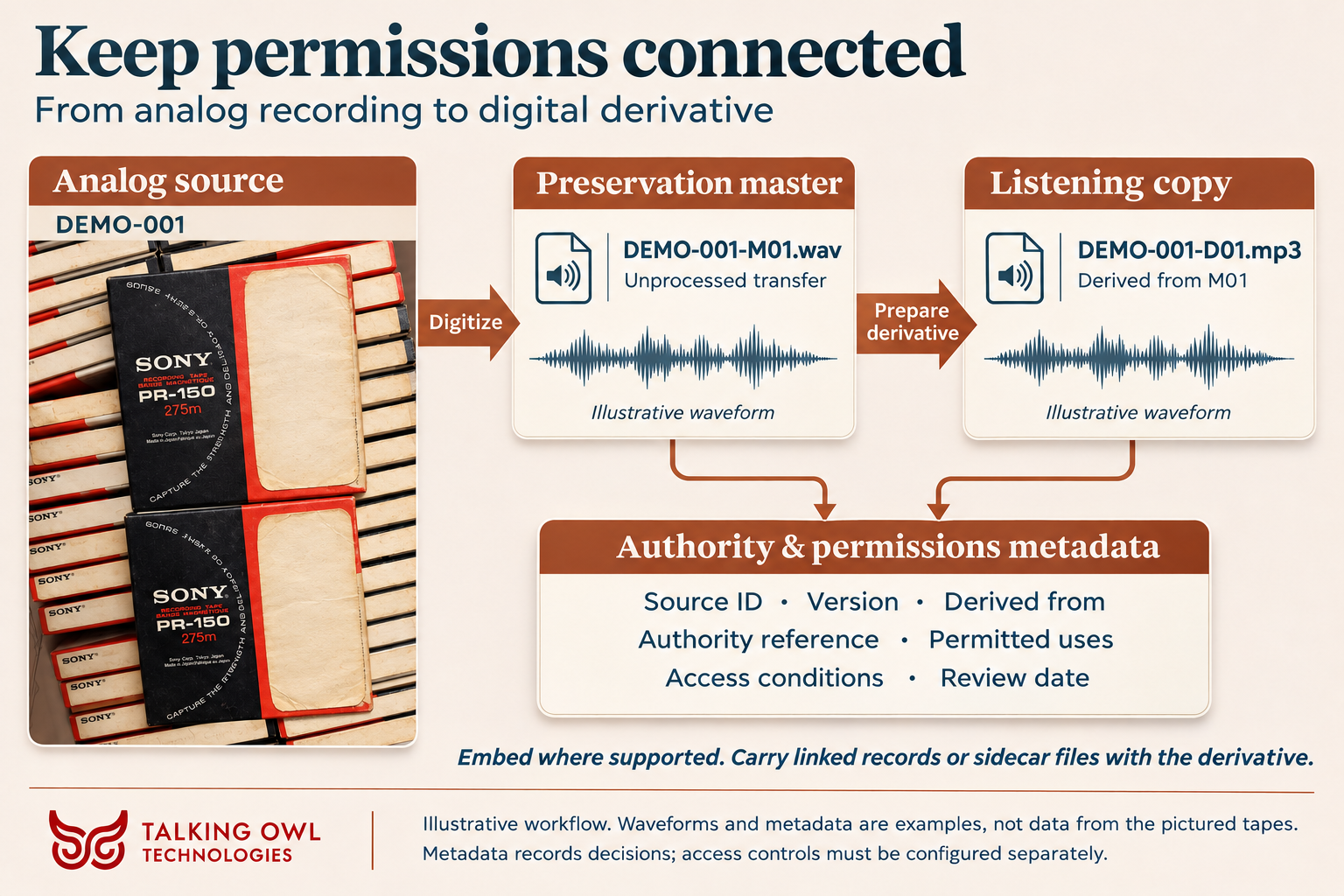
Metadata can be stripped or separated during conversion and sharing, and cannot prevent theft or unauthorized reuse on its own. Secure storage, access controls, agreements and continuing review remain essential.
Research in development
These questions shape my doctoral research and a database approach I am developing to support community-governed language collections. Building on my MA research with ReadAlongs, I am exploring connections among recordings, transcriptions, words, places and learning resources, with authority and permissions visible within those relationships.
Early prototyping uses synthetic examples. The database remains in development; community-led design, governance arrangements and technical safeguards require further work and testing.
For First Nations projects, OCAP® supports each Nation’s authority over its information. These are specifically First Nations principles, applied through the Nation’s own governance. The CARE Principles also centre people, purpose and self-determination.
A useful beginning is one authorized recording: trace its copies, check the permissions and test the handover. Explore consulting and capacity support or Talking Owl’s community-control approach for help planning that work.
OCAP® is a registered trademark of the First Nations Information Governance Centre (FNIGC).
Explore Funding & Grants for current opportunities and deadlines →


Leave a Reply